
Neurofeedback for Insomnia and Long-Standing Sleep Problems
If you have had insomnia for years you already know about screens and caffeine. Persistent insomnia is usually not a habits problem — it is an arousal problem.
In short
- Rule out sleep apnoea, thyroid, iron deficiency and medication effects first
- Long-standing insomnia often shows excess fast brain activity at sleep onset
- Evidence for insomnia specifically is thinner than for attention
- Never reduce sleep medication because training has started
The problem with most sleep advice
If you have had insomnia for years, you already know about screens, caffeine and consistent bedtimes. You have probably done all of it. Being told again is not useful.
Persistent insomnia is usually not a habits problem. It is an arousal problem: a nervous system that has learned to stay alert and cannot reliably shift into the states that produce sleep.
That is a different thing to fix, and it is why sleep hygiene advice so often fails the people who need it most.
Rule out the treatable causes first
Before considering any training, get these checked. All are common, all are treatable, and all present as poor sleep.
- Sleep apnoea. Frequently missed, particularly in men who snore and wake unrefreshed. A sleep study settles it.
- Thyroid function. Both overactive and underactive thyroid disrupt sleep.
- Iron deficiency. Associated with restless legs, which is widely under-recognised.
- Medication effects. Several common medications affect sleep architecture.
- Depression and anxiety disorders. Early-morning waking in particular warrants proper assessment.
We would not take someone into a training programme whose actual problem is untreated apnoea. Get a doctor to rule these out first.
What the brain does during poor sleep
Sleep is not a switch. It is a shift in the pattern of electrical activity across the brain, moving through stages over the night.
In people with long-standing insomnia, EEG studies commonly find excess fast activity persisting into the periods where it should be settling. Subjectively this is the experience people describe as a mind that will not stop, or lying awake physically exhausted but mentally alert.
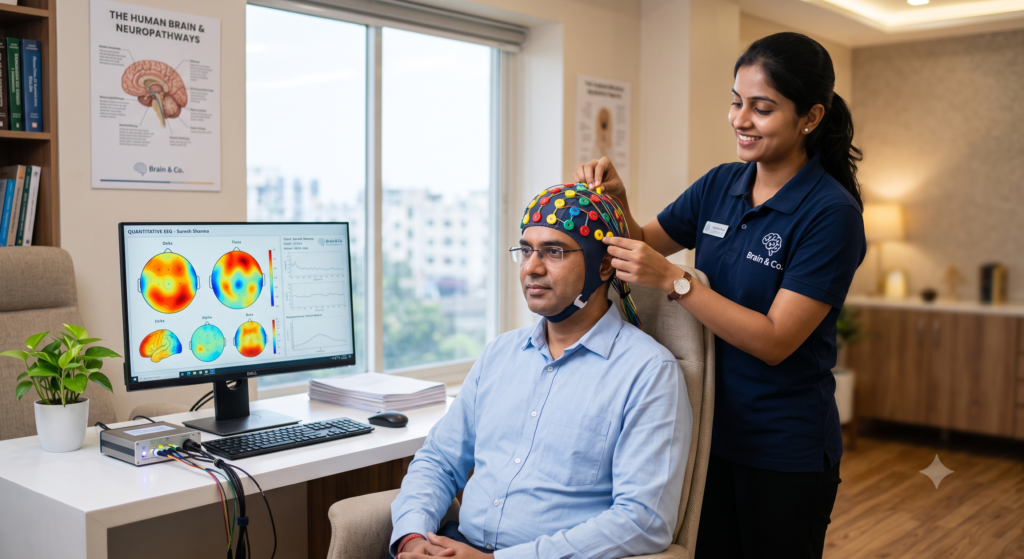
A QEEG brain map shows whether that pattern is present in your case. That matters, because if your sleep problem is not an arousal problem, training aimed at arousal is unlikely to help.

Neurofeedback for insomnia: what the evidence shows
We would rather set expectations properly than oversell this.
The strongest evidence for neurofeedback overall is in attention and impulse regulation, studied mostly in ADHD. For neurofeedback for insomnia specifically, the research base is smaller. There are positive studies, including work on protocols aimed at the sensorimotor rhythm, and there is reasonable physiological logic for why training arousal regulation would affect sleep onset. There are also fewer trials, smaller samples, and less independent replication than we would like.
Our evidence page sets out where the research is solid across the board and where it is not.
What we can say from practice is that sleep is frequently the first thing clients report changing, often between sessions six and fifteen, and often before they notice anything else. That is a consistent observation rather than a controlled finding, and it should be read as such.
What neurofeedback for insomnia involves
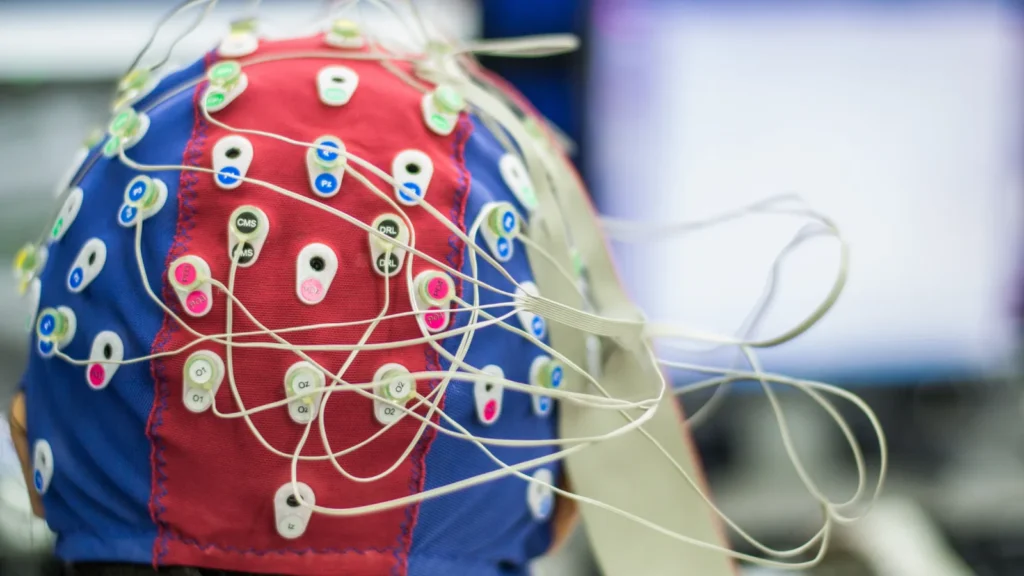
Sensors read your brain’s electrical activity and feed it back through a screen or through sound. When your brain produces the pattern being trained, the feedback continues. When it does not, it drops away. Over repeated sessions the brain learns to find that state more easily.
There is no technique to practise and no homework. You are not being taught to relax.
Most programmes run 20 to 40 sessions at two or three a week, which is covered in more detail on our sessions page.
A note on sleeping tablets
Many people arrive already taking something, often for far longer than originally intended.
Neurofeedback does not interact chemically with medication. What can happen is that as sleep changes, a dose that suited you before starts to feel too strong. If that happens it is a conversation with your prescribing doctor.
Do not reduce or stop sleep medication because you have started training. Some of these medications cause significant problems if stopped abruptly, and that is a decision for the doctor managing your care rather than for us or for you alone.
Checking who you train with
Board certification in neurofeedback is issued by the Biofeedback Certification International Alliance, whose certificants are listed publicly. The International Society for Neurofeedback and Research sets standards for the field. Ask any provider what they hold.
When this is not the answer
- You have not had the medical causes above ruled out
- Your sleep problem is driven by shift work or a schedule nothing can regulate around
- You need something to work this week
- You cannot attend twice a week for two to three months
Where to start with neurofeedback for insomnia
A QEEG assessment shows whether there is an arousal pattern worth training, and we will tell you honestly if there is not. Our sleep page covers the service itself, and the first consultation is free at either our Nashik or Mumbai centre.
Read next
Tried everything and still not sleeping?
A QEEG shows whether there is an arousal pattern worth training. The first consultation is free.
Nothing here is medical advice. Diagnosis and medication decisions belong with the doctor managing your care.