
What Happens During a QEEG Brain Map
Knowing what happens removes most of the anxiety people arrive with. Here is the appointment from start to finish, including what a brain map can and cannot tell you.
In short
- Wash hair the night before, skip conditioner and oils, avoid caffeine on the day
- The recording is passive — sensors listen, nothing passes into your head
- About an hour in total: history, cap placement, then 20 minutes of sitting still
- A QEEG describes patterns of activity. It does not diagnose any condition
Why QEEG brain mapping comes first
Most brain training sold in India runs the same protocol for everyone with the same label. Two children both diagnosed with ADHD get identical settings, despite the fact that inattention can come from very different patterns of brain activity.
QEEG brain mapping is what makes the difference. It records how your brain is actually regulating itself, then the training is built from that recording rather than from the diagnosis on paper.
This page walks through exactly what happens, because knowing beforehand removes most of the anxiety people arrive with.
Before you come in
Three things help the recording be accurate.
Wash your hair the night before and skip conditioner, oils and styling products. The sensors read tiny electrical signals through the scalp, and product residue interferes with contact.
Avoid caffeine on the day. Coffee and strong tea shift brainwave activity enough to change the picture. Sleep normally the night before as well.
Bring your medication list. Not to stop anything, but because several medications affect EEG readings and we need to interpret the map in that context. Never stop or change medication before an assessment. That is a decision for the doctor managing your care.
QEEG brain mapping, step by step
1. History and conversation, around 20 minutes
Before any equipment comes out, we talk. What brought you in, how long it has been going on, what you have already tried, sleep, medication, any head injuries, any seizure history. For a child, this is mostly a conversation with the parent, with school reports if you have them.
This matters more than people expect. The map shows patterns; the history tells us which patterns are worth training.
2. Placing the cap, around 15 minutes
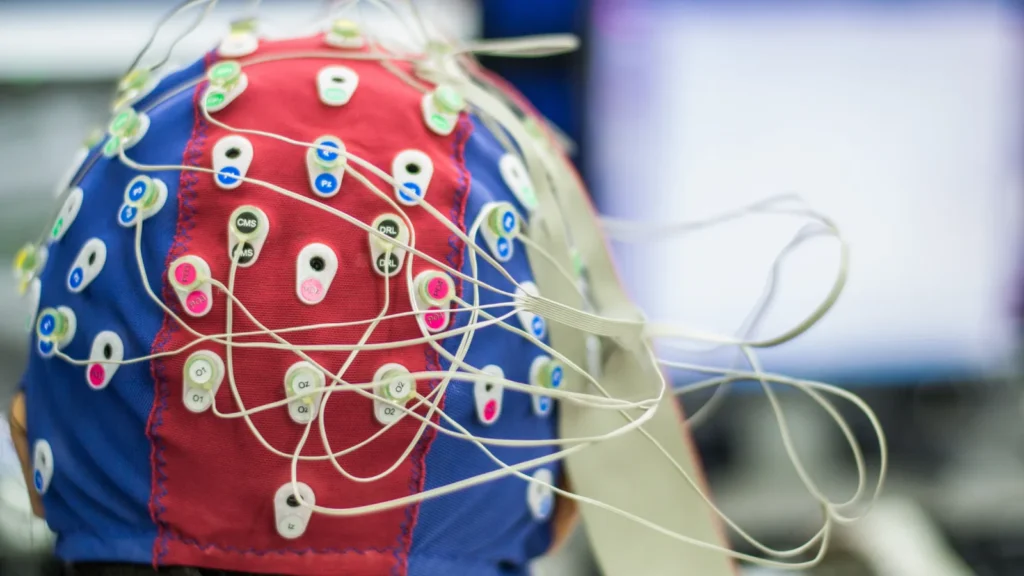
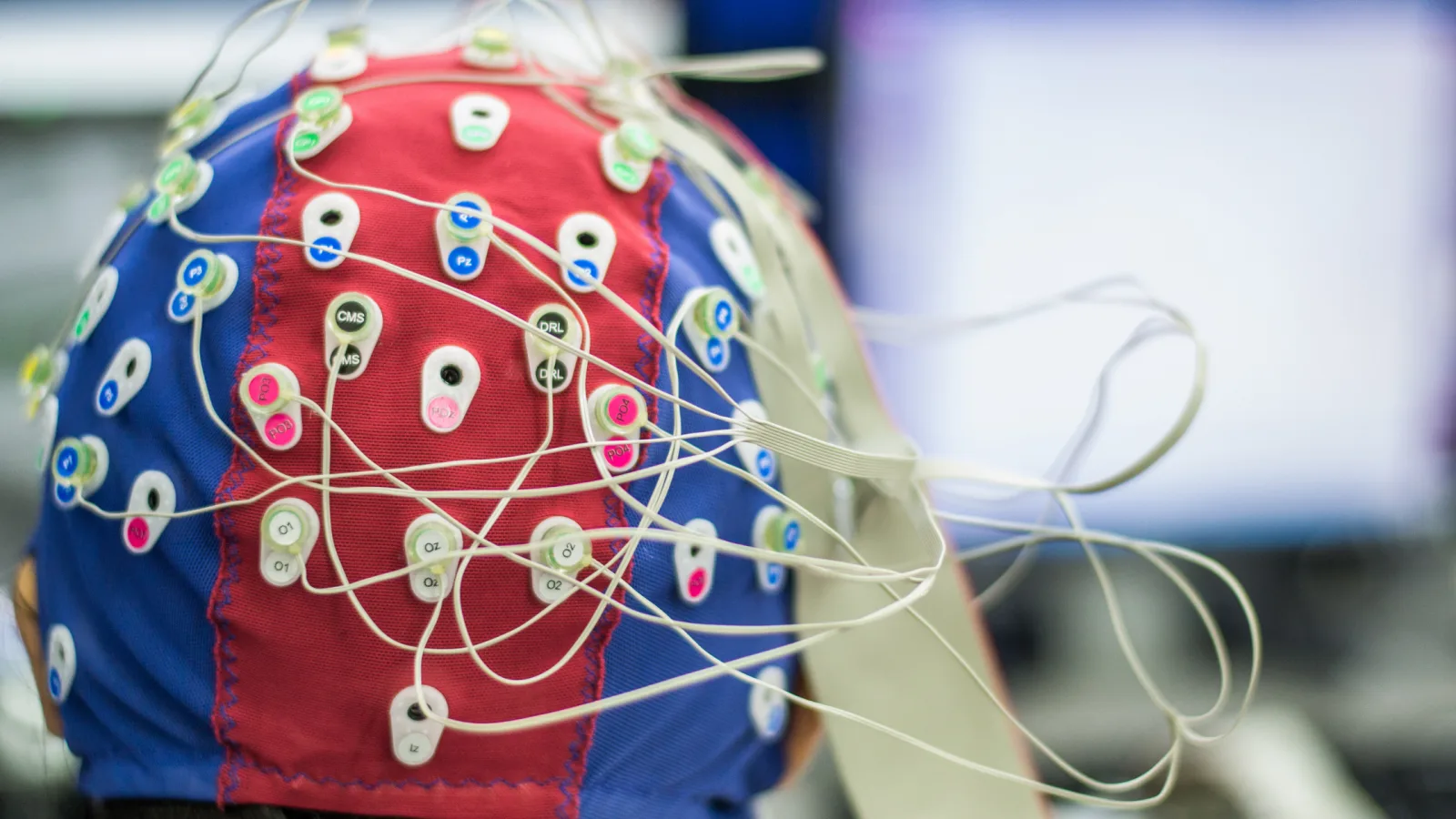
You wear a soft cap with sensors positioned at standard points across the scalp. A water-based conductive gel is applied at each point so the sensors make proper contact.
Nothing is injected, nothing is inserted, and nothing passes into your head. The sensors only listen, in the same way an ECG listens to the heart. There is no sensation beyond the gel feeling cool.
3. The recording, around 20 minutes
You sit still in a chair. For roughly ten minutes your eyes are closed, then for roughly ten minutes they are open, looking at a fixed point.
That is the whole task. You are not being tested and there is nothing to get right. Children usually manage this comfortably from around age six; for younger children we sometimes shorten it.
4. Washing up
The gel washes out with water. Most people bring a comb and head straight back to work.
What QEEG brain mapping actually shows
The recording is processed and compared against a normative database, meaning people of the same age and sex without the difficulty you came in with. What comes back is a set of maps showing where your activity sits relative to that comparison group.
In plain terms, it shows how your brain is regulating its own arousal. Some common findings:
- Excess slow-wave activity in frontal regions, often seen alongside difficulty sustaining attention
- Excess fast activity, often reported by people who describe a mind that will not switch off at night
- Difficulty shifting between states, where the brain struggles to move from alert into recovery
An important caveat: a QEEG is not a diagnostic test. It does not diagnose ADHD, anxiety, or anything else, and anyone telling you otherwise is overstating what the technology does. It describes patterns of electrical activity. Diagnosis belongs with a qualified clinician.
The results conversation
You come back for a separate appointment to go through the report. We will cover what the map shows, whether it aligns with what you described, whether training is appropriate, and roughly how many sessions we would expect.
Sometimes the honest answer is that training is not the right next step. If the map shows something that needs medical attention, the right response is a referral. If the underlying problem has never been properly assessed, that assessment comes first.
We would rather tell you that at the report stage than sell you a package.
Who should be running your QEEG brain mapping
Ask who interprets the recording and what they are qualified in. Board certification in neurofeedback is issued by the Biofeedback Certification International Alliance, and the International Society for Neurofeedback and Research is the field\u2019s professional body. Both maintain public information you can check independently.
Common questions
Where this fits
QEEG brain mapping is the assessment. If training follows, it typically runs 20 to 40 sessions at two or three a week, which we cover in detail on our sessions page. What the research does and does not support is set out on our evidence page, and safety considerations on our safety page.
We run QEEG brain mapping at both centres, in Nashik and in Mumbai. The first consultation is free.
Brain & Co. · Nashik & Mumbai
Talk to us about a QEEG brain map
Every programme starts with a conversation and a QEEG brain map, so the plan is built from your own data. Leave your number and we will call you back within one working day.
- Non-invasive, no medication involved
- Centres in Nashik (Sharanpur Road) and Mumbai (Lower Parel)
- More about a QEEG brain map at Brain & Co. →