
Brain Mapping in India: QEEG vs EEG vs MRI vs DMIT
“Brain mapping” is used in India for four very different things — and one of them doesn’t look at the brain at all. Here’s what each test measures, who it’s for, and which one you actually need.
In short
- QEEG brain mapping measures how your brain’s electrical activity compares with age-matched norms. It guides neurofeedback; it isn’t a diagnosis on its own.
- Clinical EEG is a medical test read by a neurologist, mainly for seizures and epilepsy.
- MRI shows the brain’s structure; it’s what doctors order for suspected tumours, strokes or injury.
- DMIT reads fingerprints, not the brain. The Indian Psychiatric Society has said it is not based on scientific evidence.
Why “brain mapping” is so confusing in India
Search for brain mapping in India and you’ll find hospital MRI scans, neurofeedback clinics, forensic labs and school workshops offering to reveal a child’s talents from a thumbprint — all using the same words. Parents in particular are often sold the wrong test, or pay for one that can’t answer their question.
The fix is simple: ask what the test actually measures. Once you know that, it’s easy to see which one fits your situation.
QEEG vs EEG vs MRI vs DMIT at a glance
| QEEG | Clinical EEG | MRI / fMRI | DMIT | |
|---|---|---|---|---|
| What it measures | Brainwave activity, compared with age-matched norms | Brainwave activity, read visually for abnormal patterns | Brain structure (MRI) or blood-flow changes (fMRI) | Fingerprint patterns |
| Main use | Planning and tracking neurofeedback; understanding attention, sleep and arousal patterns | Diagnosing seizures and epilepsy; some sleep and coma assessments | Tumours, stroke, injury, MS; fMRI is mostly research | Marketed for talents, learning style and careers |
| Who reads it | Trained QEEG / neurofeedback clinician | Neurologist | Radiologist | Sales counsellor |
| Invasive? | No | No | No (contrast sometimes injected) | No |
| Scientific basis | Established method; interpretation needs expertise | Standard medical test | Standard medical test | Not supported by evidence |
QEEG brain mapping: what it is and what it isn’t
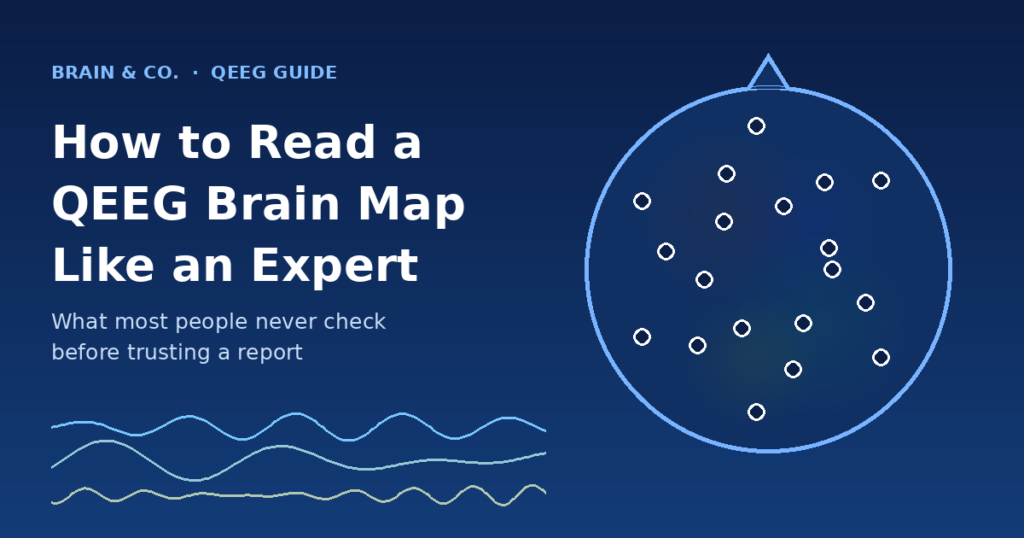
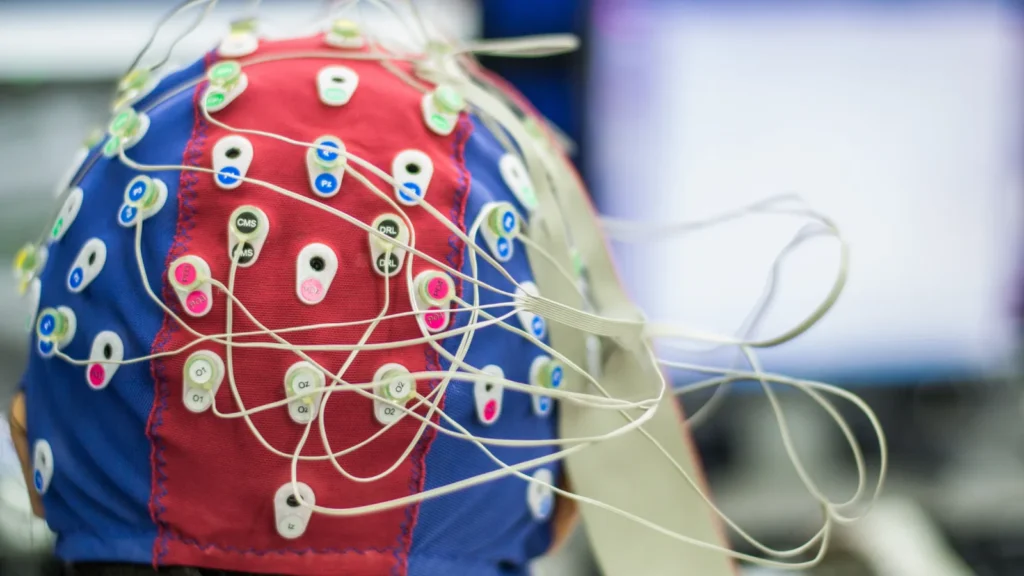
A QEEG (quantitative electroencephalogram) records brain activity from 19 sensors in a soft cap, usually with eyes open and eyes closed, sometimes during a simple task. Software then compares your recording with a database of people of the same age and shows the results as colour-coded maps: where activity is faster or slower than expected, and how well different regions are communicating. New to this? Our beginner’s guide to QEEG brain mapping walks through a session step by step.
What a QEEG is good for:
- Planning a personalised neurofeedback programme rather than using a generic protocol.
- Understanding patterns linked to attention, sleep, over-arousal and fatigue.
- Tracking change with a repeat map during or after training.
What a QEEG is not: a standalone diagnosis. It can’t tell you on its own that someone “has ADHD” or “has depression” — those are clinical diagnoses made by doctors and psychologists using history, observation and rating scales. A good centre will say this plainly. For a walk-through of the appointment, read what happens during QEEG brain mapping.
Clinical EEG: the neurologist’s test
A clinical EEG uses similar sensors, but it answers a different question. A neurologist reads the raw trace looking for abnormal events — most importantly, the spikes and patterns associated with seizures. It’s the right test for:
- Fits, blank spells or unexplained collapses
- Suspected epilepsy, and monitoring known epilepsy
- Some sleep disorders (as part of a sleep study)
If you or your child has had anything that looks like a seizure, see a neurologist first. A QEEG and neurofeedback centre is not the place to start.
MRI and fMRI: pictures of structure
An MRI scan uses a strong magnet to create detailed images of the brain’s structure. It’s what doctors order to look for tumours, bleeding, stroke, inflammation, multiple sclerosis or injury. An fMRI tracks blood-flow changes as a marker of activity; it’s a powerful research tool, but is rarely used for routine clinical decisions.
MRI doesn’t show brainwave rhythms, and a normal MRI doesn’t mean attention, sleep or mood can’t be affected. The two tests look at completely different things.
Go to an emergency department immediately for a sudden severe headache, new weakness or numbness on one side, slurred speech, confusion, a first seizure, or symptoms after a head injury. These need urgent medical imaging, not brain training.
DMIT: why a fingerprint test is not brain mapping
DMIT (Dermatoglyphics Multiple Intelligence Test) is widely sold to Indian parents — often through schools — as a way to discover a child’s inborn talents, learning style, “brain dominance” or ideal career from their fingerprints. No sensors are placed on the head. Nothing about the brain is measured.
In 2019, the Indian Psychiatric Society issued a position statement on DMIT stating that it is not based on scientific evidence and cautioning parents and schools against it. Fingerprint patterns form before birth and do not change; they cannot reflect how a child’s brain is developing, what they are good at, or what they should study.
What we suggest to parents:
- Don’t make school, subject or career decisions from a DMIT report.
- Be cautious about handing over children’s fingerprints and personal data to private companies.
- If you’re worried about attention, learning or behaviour, talk to your child’s paediatrician, a child psychologist, or a qualified educational assessor. For attention and focus, a QEEG-guided plan is one evidence-informed option — see neurofeedback for children and academic success.
Forensic “brain mapping” and the law
You may also see “brain mapping” in Indian news about criminal investigations. This usually refers to the Brain Electrical Oscillation Signature (BEOS) or Brain Electrical Activation Profile (BEAP) tests, which record EEG responses to crime-related words or images. In Selvi v. State of Karnataka (2010), the Supreme Court of India held that narco-analysis, polygraph and BEAP tests cannot be administered without the person’s consent, citing the right against self-incrimination and the right to personal liberty. This has nothing to do with clinical care or neurofeedback.
Which brain test do you actually need?
- Seizures, fits or blank spells → see a neurologist for a clinical EEG.
- Sudden severe headache, weakness, confusion or head injury → emergency care and MRI/CT as your doctor advises.
- Attention, focus, sleep, stress or exam pressure, where medical causes have been considered → a QEEG to plan neurofeedback therapy. See ADHD, sleep, anxiety and exam stress.
- Choosing subjects or a career → a qualified career counsellor or psychometric aptitude assessment — not fingerprints.

Questions to ask before you book a QEEG
- How many channels do you record? (19 is standard for a full map.)
- Which normative database do you compare against?
- Who reviews the recording for artefacts like blinks and muscle tension?
- Will someone qualified explain the report to me in person, in plain language?
- Will you tell me clearly if something should be seen by a doctor first?
QEEG brain mapping in Nashik and Mumbai
Brain & Co. offers QEEG brain mapping for children and adults at our Nashik centre and Mumbai centre. Every map is reviewed by a trained clinician and explained to you in person, with a clear note on what it can and can’t tell you, and a referral to a doctor where that’s the better next step. If neurofeedback is a good fit, your map becomes the basis of a personalised training plan.
Frequently asked questions
Read next
Get a brain map that measures the brain
A 19-channel QEEG, reviewed by a trained clinician and explained to you in person — in Nashik or Mumbai.
This guide is for general information and is not medical advice. QEEG brain mapping is not a standalone diagnostic test. For seizures, head injury or sudden neurological symptoms, seek medical care immediately.
Brain & Co. · Nashik & Mumbai
Talk to us about a QEEG brain map
Every programme starts with a conversation and a QEEG brain map, so the plan is built from your own data. Leave your number and we will call you back within one working day.
- Non-invasive, no medication involved
- Centres in Nashik (Sharanpur Road) and Mumbai (Lower Parel)
- More about a QEEG brain map at Brain & Co. →