
Neurofeedback for Autism: What Parents Should Know
Neurofeedback is not a treatment for autism, and any clinic saying otherwise is selling you something. Here is what the research actually supports.
In short
- Neurofeedback does not address the core features of autism
- Research has looked at co-occurring attention, sleep and regulation difficulties
- The evidence here is thinner than for ADHD, with small studies and limited replication
- Sensory tolerance of the cap is often the deciding practical question
Why parents look into this
Most families arrive here after a long stretch of trying things. Occupational therapy, speech therapy, sensory integration work, sometimes medication for associated difficulties like sleep or irritability.
Neurofeedback usually comes up as a question rather than a plan: does training the brain directly do anything that the other therapies do not?
This page answers that as honestly as we can, including where the evidence is weaker than we would like.
Neurofeedback for autism: what the research supports
Being direct about this matters more here than almost anywhere else, because families of autistic children are targeted with a great deal of unsupported treatment marketing in India.
Neurofeedback for autism is not a treatment for autism itself. It does not address the core features of autism, and there is no credible evidence that it does. Any clinic suggesting otherwise is selling you something.
What has been studied is narrower. Research into neurofeedback for autism in children has mostly looked at co-occurring difficulties rather than autism itself, particularly attention, hyperactivity, sleep and emotional regulation. Some studies report improvements in those areas. The studies tend to be small, the designs vary considerably, and independent replication is limited.
The honest summary is that the evidence base here is thinner than for ADHD, which is the best-studied application of neurofeedback. We think it is reasonable to consider for specific co-occurring difficulties. We do not think the evidence supports it as a treatment for autism, and we will say the same thing to you in person.
Where neurofeedback for autism may be worth considering
The families who get most out of this tend to come with a specific difficulty rather than a general hope.
- Attention and hyperactivity where these co-occur with autism. This is the area with the strongest supporting research.
- Sleep difficulties, which are extremely common and affect everything else. Sleep is also often the first thing that shifts.
- Emotional regulation — the intensity and duration of distress, rather than the triggers themselves.
Note what is not on that list: communication, social understanding, and the core characteristics of autism. We do not claim those change, because the evidence does not support it.
The practical questions
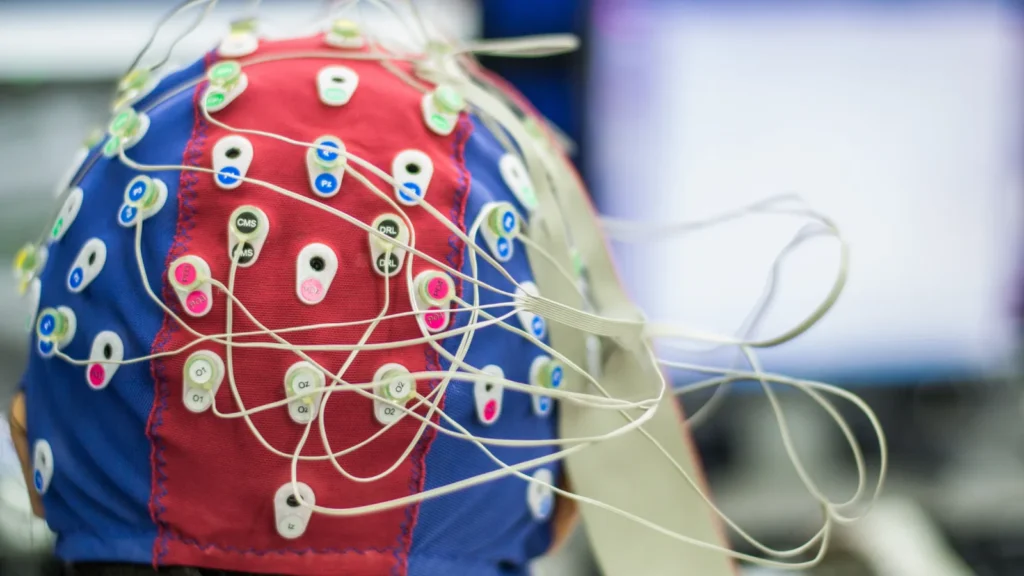
Will my child tolerate the sensors? This is the real question, and for sensory-sensitive children it is often the deciding one. Some children manage the cap without difficulty. Others find it intolerable, and for them this is not a suitable approach.
We work this out at the assessment rather than after you have paid for a package. If your child cannot tolerate the cap, we will tell you.
Can my child sit still for a session? Sessions run 30 to 45 minutes with feedback delivered through films or games. Many autistic children do this well, particularly those who engage readily with screens. Shorter sessions are possible.
How many sessions? Typically 20 to 40, at two or three a week. That is a real commitment of time and travel on top of existing therapies, and worth being realistic about before starting.
Does it replace other therapies? No. If your child is making progress with speech or occupational therapy, that continues. Neurofeedback is not a substitute for it.
What happens before neurofeedback for autism begins
Every child starts with a QEEG brain map rather than a standard protocol. The recording takes about 20 minutes of sitting still, with roughly half eyes closed and half eyes open. Our parent’s guide covers what the session itself involves in more detail.
Two things the assessment is for. It tells us what, if anything, is worth training. And it tells us honestly whether this is the right approach for your child at all.
When we would say no
We would rather turn work away than take it in these situations:
- Your child cannot tolerate the sensors
- You are hoping for change in the core features of autism
- The family cannot realistically attend twice a week for two to three months
- There is a seizure history that has not been discussed with a neurologist. Seizure disorders co-occur with autism more often than in the general population, and this needs coordinating with the doctor managing that care rather than working around it.
Checking a provider
Board certification in neurofeedback is issued by the Biofeedback Certification International Alliance, and certificants appear in a public directory. The International Society for Neurofeedback and Research publishes standards for the field. Anyone offering neurofeedback for autism should be willing to tell you what they are certified in.
A word on the wider picture
Families of autistic children in India are offered a lot of interventions, some evidence-based and many not. A reasonable filter is to ask any provider three questions: what specifically will change, what is that claim based on, and what will you tell me if it does not work.
Ask us those questions too. We would rather you arrived sceptical than hopeful.
Assessments run at both centres, in Nashik and Mumbai, and the first consultation is free.
Read next
Want an honest assessment first?
We will tell you if we do not think this is right for your child. The first consultation is free.
Nothing here is medical advice. Diagnosis and medication decisions belong with the doctor managing your care.
Brain & Co. · Nashik & Mumbai
Talk to us about neurofeedback
Every programme starts with a conversation and a QEEG brain map, so the plan is built from your own data. Leave your number and we will call you back within one working day.
- Non-invasive, no medication involved
- Centres in Nashik (Sharanpur Road) and Mumbai (Lower Parel)
- More about neurofeedback at Brain & Co. →