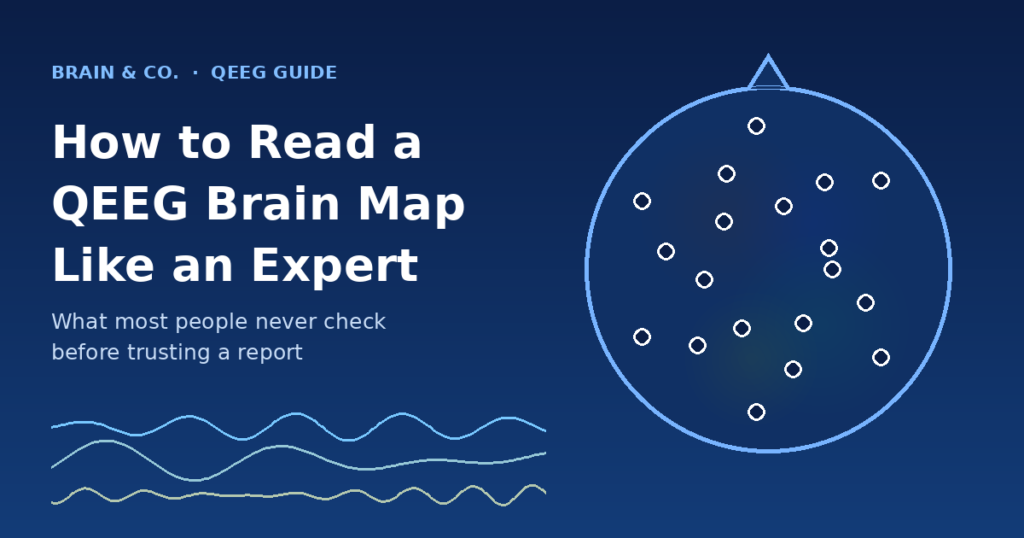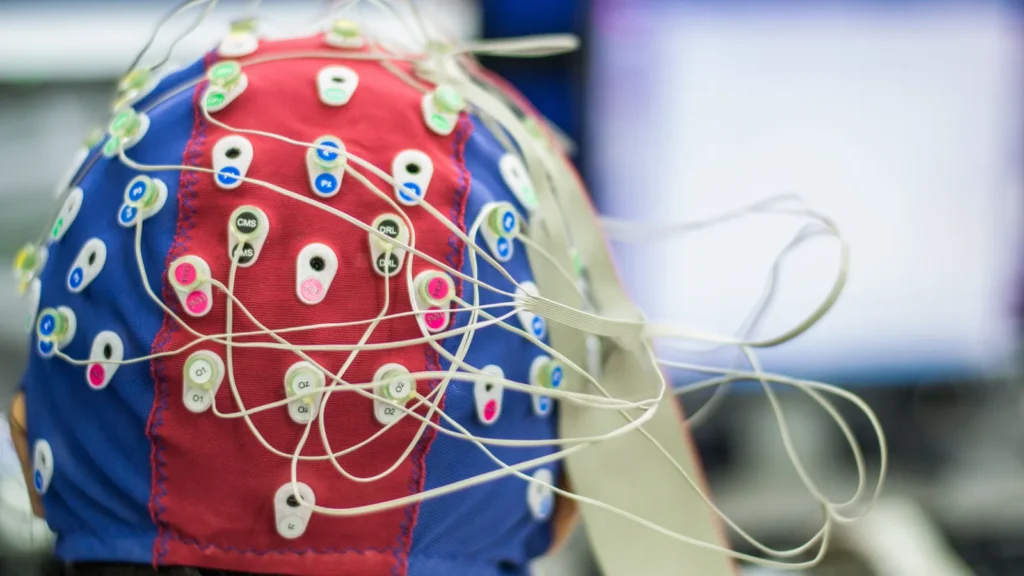

Short answer: before you trust a QEEG brain map, check (1) how much clean, artefact-free data it is built on, (2) which state was recorded (eyes closed, eyes open, task), (3) which normative database was used, (4) where your own alpha peak sits, (5) connectivity and symmetry, not only power, (6) that it is not a diagnosis, and (7) that it leads to a plan that gets re-measured.
A QEEG brain map looks authoritative: coloured scalp diagrams, numbers, standard deviations. That is exactly why it is easy to misread. Two people can look at the same report and reach opposite conclusions, and the difference is rarely the software. It is the habits of the person reading it.
This article is for anyone who has had, or is considering, a QEEG. If you are new to the topic, start with our beginner’s guide to QEEG brain mapping. What follows is the next layer: the checks experienced clinicians run before they trust a map.
1. Start with the recording, not the map
A QEEG map is a statistical summary of a raw EEG recording. If the recording is poor, the map is poor, however polished it looks. Before any colour is interpreted, a careful reader scrolls through the raw traces and asks how much of the data is actually brain activity.
- Eye blinks and movements add slow, large waves at the front of the head that can look like excess slow activity.
- Jaw and neck muscle tension adds fast, spiky activity, especially at the temples, that can look like excess fast activity.
- Drowsiness pushes activity towards slower frequencies. A tired recording can mimic a "slow brain".
- Poor electrode contact distorts a single site and can paint a false hot spot.
Good practice is to clean the recording by selecting artefact-free segments, and to say how many seconds of clean data the map is built on. A map built on a few minutes of well-cleaned data deserves more trust than one built on a long recording nobody inspected.
2. Know what state the person was in
Brain rhythms change with state. Eyes open and eyes closed give very different pictures, and so does a person who has slept badly, skipped a meal, had a lot of caffeine, or is simply anxious about being tested. Most clinics record both eyes-closed and eyes-open conditions, and sometimes a task. An expert always asks which condition a pattern appears in. A feature that shows up only in one state is a different story from one that appears in all of them.
3. Treat the normative database as a reference, not a verdict
The colours on a QEEG map usually show how far a measurement sits from an average built from a database of people. That comparison is useful, but it has limits that are easy to forget:
- A value outside the typical range is unusual, not necessarily a problem. A meaningful share of healthy people sit outside the range on at least one measure.
- Databases differ in age ranges, how participants were screened, and the equipment used. Matching your equipment and recording method to the database matters.
- Z-scores on dozens of sites and bands create many comparisons. A few will look striking by chance alone.
The practical habit is to look for patterns that make sense together, not single red squares.
4. Look at the individual alpha peak
Most people have a dominant alpha rhythm that peaks at a personal frequency, often somewhere around 9 to 11 Hz, and it varies with age and from person to person. Reports that use fixed frequency bands can mislabel someone whose peak sits slightly higher or lower than average. Experienced readers check where the individual peak sits before deciding what "slow" or "fast" means for that person.
5. Read connectivity and symmetry, not only power
Power maps show how much activity there is at each site. Measures of coherence, phase and left-right symmetry describe how regions are working together. A map can look unremarkable on power and still show a pattern worth discussing in how regions communicate. These measures are also more sensitive to recording quality, which is one more reason to start with clean data.
6. Remember what QEEG is not
A QEEG is not a diagnostic test for ADHD, anxiety, depression or any other condition. No map can tell you that you "have" a condition. Diagnosis comes from a clinical assessment by a qualified doctor or psychologist. What a QEEG can do is describe how your brain’s electrical activity looks under defined conditions, which helps a trained practitioner decide whether a neurofeedback programme is a sensible option and which sites and frequencies to train. For how it differs from other tests, see our guide to EEG, MRI and brain mapping compared.
7. Check that the map leads to a plan, and the plan gets re-measured
The point of a map is a plan. A good programme explains in plain language what was found, why a particular site or frequency is being trained, what you should notice and when, and how progress will be checked. Repeat measures, along with your own reports of sleep, focus, mood or study, show whether the approach is working for you. If a provider cannot explain the link between your map and your training, ask for it in writing.
Five questions to ask before you trust any QEEG report
- How much clean, artefact-free data is this map based on?
- Which conditions were recorded (eyes closed, eyes open, task)?
- Which normative database was used, and does it match my age and the equipment?
- What does the pattern mean for me, in plain language, and what does it not mean?
- How will we measure whether training is helping, and when will we review it?
If you would like a team that explains the map in plain language, you can read how it fits into neurofeedback in India, or request a free call back using the form below. Brain & Co. has centres in Nashik and Mumbai.
This article is general education and not medical advice. If you or someone close to you is in distress, call Tele-MANAS on 14416 (free, 24×7).
Frequently asked questions
Brain & Co. · Nashik & Mumbai
Talk to us about a QEEG brain map
Every programme starts with a conversation and a QEEG brain map, so the plan is built from your own data. Leave your number and we will call you back within one working day.
- Non-invasive, no medication involved
- Centres in Nashik (Sharanpur Road) and Mumbai (Lower Parel)
- More about a QEEG brain map at Brain & Co. →