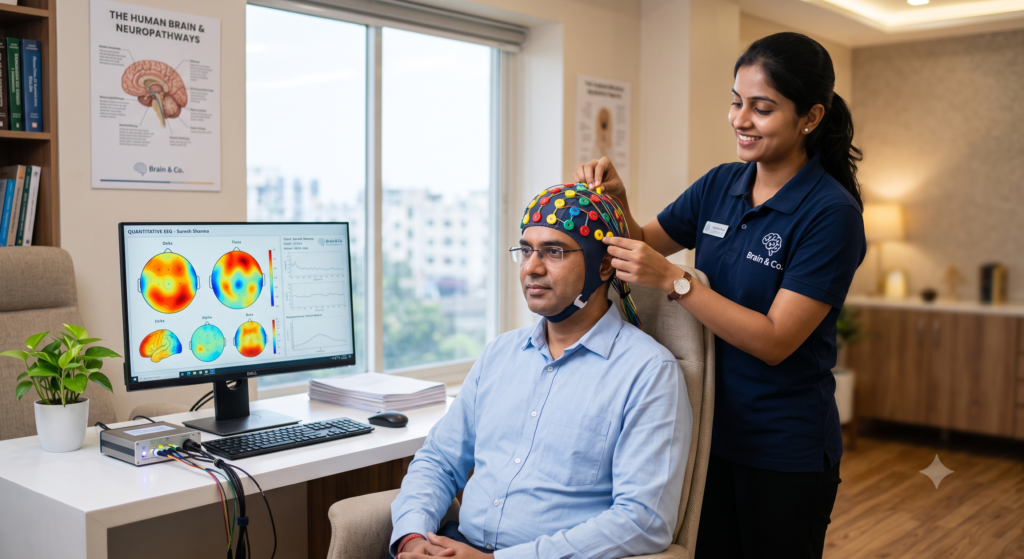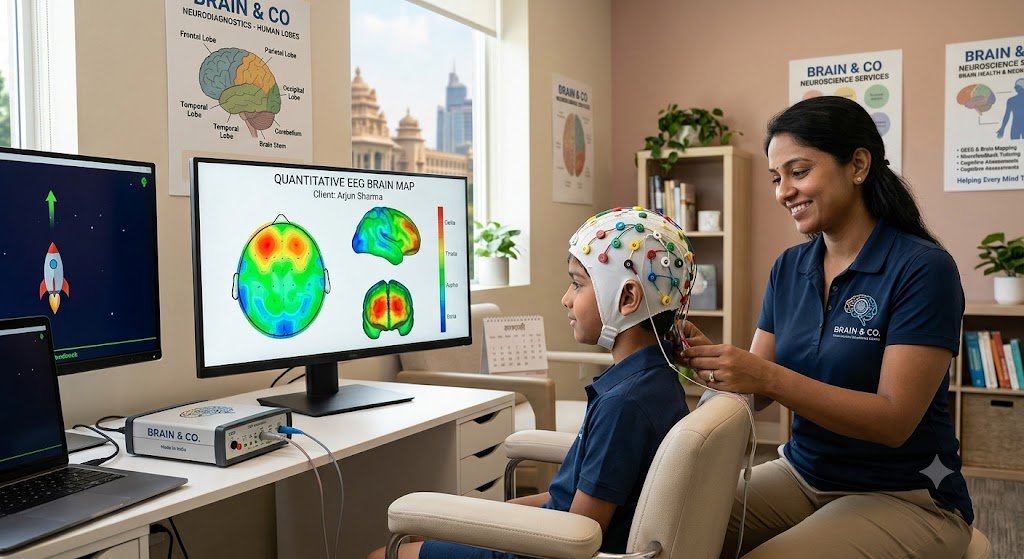

Neurofeedback works by teaching your brain how to guide itself. During a session, sensors placed on your head read brain activity and show it back to you as sounds or visuals.
When your brain follows healthy patterns, it gets rewarded with positive feedback. Over time, this helps the brain form better habits for focus, calmness, and overall balance.
It’s not medicine but real-time training that builds self-control inside the mind. In this article, you’ll explore what neurofeedback therapy actually is, how brainwaves are trained, which areas of the brain are targeted, and the benefits and limits of this approach.
If you’re curious about how this “brain gym” really works, keep reading to find out.
What Is Neurofeedback Therapy?
To put it in simpler words, Neurofeedback is like a personal trainer for your brain. It teaches your brain to follow positive patterns by reinforcing affirmations when it works the correct way.

And all of this happens in real time. During a Neurofeedback session, small sensors track your brainwaves, and “reward” your brain with auditory or visual signals upon following desired patterns.
The goal is to train your brain to manage itself effectively. The reward feedback, when followed consistently, shows more positive changes over time.
In clinical trials, theta/beta neurofeedback (which rewards lower theta / higher beta activity) has been shown to reduce theta power in resting EEG.
And in the neurofeedback group, greater theta reduction was correlated with larger improvements in ADHD symptoms (Janssen et al., 2016).
Neurofeedback stands out from traditional conversational or medicinal therapy because the healing happens in real time rather than following suggestions out of the session, and it is completely non-invasive.
How Does Neurofeedback Work?
Neurofeedback uses neuroplasticity, the brain’s ability to change itself over time. By recognizing patterns and rewarding desired activity, it gradually strengthens healthier brain pathways and improves overall cognitive and emotional regulation.

As an extensive review notes, neurofeedback establishes closed-loop feedback systems that let users modulate their own brain activity in real time, facilitating lasting neural changes.
1. EEG Sensors Detect Brain Activity
EEG sensors pick up the brain’s cortical electrical signals. These signals are immediately translated into visual or audio feedback on a screen, allowing the brain to observe and respond in real time.
2. Desired Patterns Bring Rewards
When the brain produces beneficial patterns such as calm alpha waves or focused beta waves, it receives rewards like smooth videos or pleasant tones, reinforcing the positive neural state.
3. Interrupting Undesired Patterns
If unhelpful patterns linked to inattention or stress appear, the system disrupts feedback. This interruption signals the brain to self-correct, gradually weakening dysfunctional pathways and encouraging healthier activity.
4. Learning via Operant Conditioning
Through repeated reinforcement, the brain learns operant conditioning. Over time, neurofeedback directly trains neural pathways, strengthening networks like the Default Mode Network, with effects persisting even beyond training sessions.
Recent research has shown that short neurofeedback regimes can elicit white matter plasticity (i.e. structural changes in neural wiring), not just momentary changes in brainwave patterns.
Unlike relaxation techniques, neurofeedback engages the brain directly. By combining pattern recognition, reward, and correction, it leverages neuroplasticity to create long-term, healthier brain activity that sustains outside training sessions.
What Happens During A Neurofeedback Session?
A typical Neurofeedback session is pretty straightforward and relaxed. You can call it watching a movie!
It starts with you sitting in a comfortable chair, then placing EEG sensors on your scalp, which do not interact with the brain directly but merely read its electrical activity.
According to a methodological review, neurofeedback setups typically employ non-invasive, passive recording of cortical signals with online feedback loops.
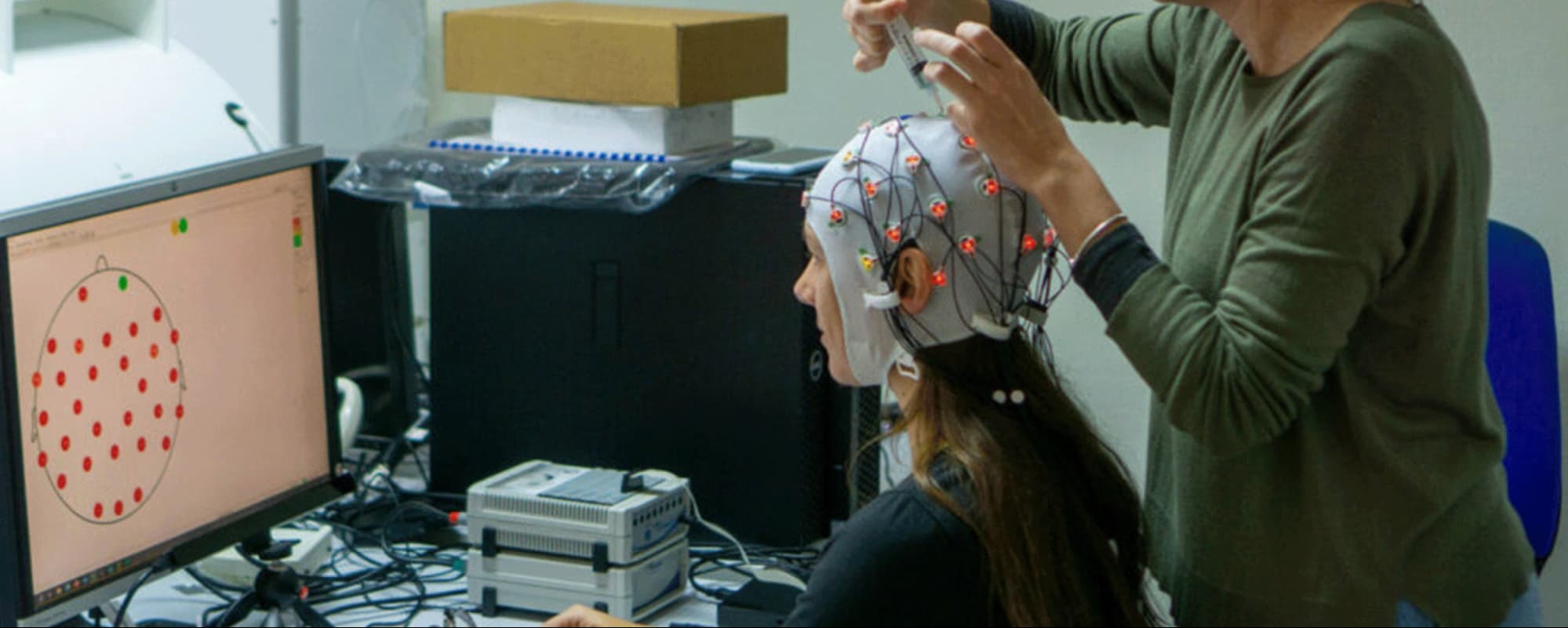
These signals are translated by specialized software that understands the brainwaves that are being produced.
Every session is tailored to the patient’s needs. For example, the aim for increasing focus in ADHD is to reduce theta waves (4-7 Hz), while the objective for relaxation is to increase alpha waves (8-12 Hz).
The patient’s role is passive, as they only react and engage with the auditory and visual output playing in front of them. This output is a response to the brain’s electrical activity.
In one training intensity study, participants underwent either four 37.5-minute neurofeedback runs on consecutive days or six 25-minute runs spread out, showing measurable EEG modulation even within a single session.
If your brain is behaving well, you get pleasant feedback, and if it is being wrongly stimulated, the input is interrupted to signal your brain to change its patterns.
Each session typically lasts somewhere between 30 and 60 minutes. It is a completely safe and comfortable experience, comparable to “going to the gym for your brain”, as it involves a gradual increase in stronger and more positive neural behavior.
In more clinical protocols, participants might have three 8-minute feedback blocks separated by rest, for example, in neurofeedback for depression.
What Areas Of The Brain Are Targeted By Neurofeedback?
Neurofeedback is a very targeted and focused process; each session has its focus narrowed down to the patient’s needs. This means training different parts of the brain that deal with the various issues the patient is experiencing.
Here are the different parts of the brain and what role they play in dealing with and eventually receiving training to improve different mental conditions.
1. Frontal Cortex: Including the prefrontal cortex region, this part of the brain is heavily responsible for planning, active memory, and impulse control. Training in this area is aimed at improving focus and attention, especially for individuals with conditions like ADHD.
In fact, a study showed that neurofeedback of the right inferior frontal cortex led to increased activation in that region plus stronger connectivity with the anterior cingulate and dorsal caudate, which correlated with symptom improvement.
2. Amygdala and Limbic System: It is the official emotional control centre of the brain. Training these parts helps regulate your emotional responses and stress. When faced with training for conditions like anxiety and PTSD, these parts are the target to condition for the better.
For example, Ros et al. found that alpha desynchronization neurofeedback in PTSD patients shifted amygdala complex connectivity from fear/emotion memory areas toward prefrontal regulation regions, along with reductions in arousal.

3. Anterior Cingulate Cortex: This is another crucial area for regulating emotional inhibition and resilience. It is also targeted when training for PTSD and anxiety; conditioning this area will affirm positive patterns to deal with fear and other such emotions.
A real-time fMRI study on PTSD showed that patients could learn to upregulate ACC via neurofeedback, and that the degree of ACC regulation was linked to how severe symptoms were, meaning more ACC control meant better emotional regulation.
4. Left Dorsolateral Prefrontal Cortex: This region is associated with the experience and expression of positive emotions, and is sometimes targeted when training for conditions such as depression. Aiming to stimulate activity in this region helps in positive pattern building.
In a preliminary report, researchers training the left DLPFC via neurofeedback found that improved ability to upregulate the left DLPFC was significantly linked with reductions in depressive symptoms and rumination.
5. Posterior Cortex: The alpha rhythms in this part of the brain are important to slip into a state of rest and sleep. Targeting this area with Neurofeedback helps with issues like insomnia.
For instance, a study targeting the posterior cingulate cortex (a major posterior node) in PTSD patients showed that downregulating PCC changed its connectivity with DMN and salience network regions, which was associated with symptom relief.
What Brainwaves Are Trained In Neurofeedback?
We’ve already talked about how Neurofeedback is a type of brain training that relies on reading and understanding your brain’s activity.

This activity is measured in brainwaves, which are essentially the electrical rhythms your brain produces. Neurofeedback works by training and rebalancing these rhythms. The five main types of brainwaves are:
- Delta (0.5 – 4 Hz): The slowest of the brainwaves, which are most active when you are in deep and completely dreamless sleep.
- Theta (4 – 7 Hz): These waves occur when a person is in deep relaxation, often during creative processes and daydreaming. An excess of these brainwaves is actually linked to conditions like ADHD.
A study by Janssen et al. (2016) demonstrated that neurofeedback training targeting theta/beta ratios led to reductions in theta power and improvements in ADHD symptoms.
- Alpha (8 – 12 Hz): Another type of brainwaves that occur when you are calm and relaxed, but also when you are awake. They are trained to happen more when dealing with conditions like anxiety and insomnia.
Neurofeedback training to enhance alpha wave activity has been shown to improve subjective sleep quality in individuals with insomnia.
- Beta (13 – 30 Hz): The waves of thought, they are buzzing when you are in deep thinking, or focused and alert to solve a problem. In people with ADHD, these are observed to be less present, while an excess is seen in people with anxiety or hyperarousal.
- Gamma (30 – 100 Hz): The fastest of all the brainwaves, and most active when the person is involved in complex tasks like learning and active memory. Due to their complexity compared to the others, they are less targeted in Neurofeedback.
The aim and practice of Neurofeedback will always remain in training these brainwaves to be more or less active, depending on the patient’s needs and conditions.
The Science Behind Neurofeedback Training
As we’ve already discussed, Neurofeedback heavily relies on the involvement of neuroplasticity and operant conditioning. Let’s revisit the science behind it, one by one.
Neuroplasticity is the ability of the brain to form new neural pathways and change its behavior constantly.
Every time a “neural circuit” (a collection of neurons and other cells that communicate via synapses) is stimulated again and again, the synaptic pathways present there get stronger.

This is what makes it easier for that pattern in the brain to be repeated more in the future.
Operant conditioning, on the other hand, is a learning process. It involves reinforcing desired behaviors through the use of immediate rewards.
Research indicates that neurofeedback participants learn to regulate their own neural dynamics through rewarding feedback, aligning with operant conditioning principles.
By linking the electrical output from your brain (as read by the EEG) to audiovisual rewards, Neurofeedback uses this principle to promote changes in your brain’s activity.
Studies have shown that neurofeedback can activate self-regulatory responses, leading to normalization of abnormal neural patterns, demonstrating the application of operant conditioning in brain training.
This method is distinct from a placebo or simple relaxation techniques because the changes are actually and objectively measurable through imaging studies like fMRI and sLORETA analysis.
This research shows that neurofeedback training can cause long-term changes in intrinsic brain connectivity, providing evidence of its measurable effects.
And as previously stated, Neurofeedback changes the active connectivity in the main networks of the brain, like DMN and other regulatory circuits.
Different from medication with broader effects, Neurofeedback changes and targets activity in very specific and localized areas related to specific issues.
Scientific Evidence On Neurofeedback
The scientific evidence on Neurofeedback varies across different conditions.
1. For ADHD, meta-analyses (Arns et al., 2009; Cortese et al., 2016) convey a moderate size of evidence but sizable positive change in attention and focus, along with impulse control. Long-term effects show lasting benefits even after treatment.
2. For PTSD, studies display a lowering of re-experiencing and hyperarousal symptoms. Peniston & Kulkosky (1991) pioneered alpha-theta protocols in veterans with promising results.
Anxiety disorders show positive findings for symptom reduction and improved emotional regulation.
In fact, Neurofeedback training targeting alpha activity over the parietal lobe in this trial has been shown to improve anxiety traits in individuals with generalized anxiety disorder, with sustained effects over time.
For depression and insomnia, the evidence is still coming up, but comparatively less aggressive than for ADHD. The limitations are a small sample size and a lack of standards in training guidelines, along with other things like mixed protocols.
Apart from the study on depression discussed above, A randomized controlled trial demonstrated that neurofeedback training significantly improved sleep quality in individuals with insomnia, with reductions in beta waves and increases in theta and alpha waves.
Placebo-controlled studies are difficult since participants observe active feedback. Despite these issues, MRI and EEG studies confirm neurophysiological changes linked with symptom improvement.
This makes Neurofeedback one of the more evidence-supported neuromodulation therapies outside direct brain stimulation.
What Does Neurofeedback Help With?
Neurofeedback has been a proven, flexible tool for both clinical settings and performance enhancement. It is used to improve mental conditions but is also applied in sports, music, and corporate environments.
Here are the more researched applications of Neurofeedback –
- ADHD is one of the most well-researched conditions in Neurofeedback, as the therapy helps improve a person’s attention and focus.
- Anxiety and Depression are other areas where Neurofeedback can help, by reducing feelings of being on edge and assisting with emotional regulation.
- PTSD is often targeted, as the therapy helps retrain overactive emotional systems in trauma survivors and combat veterans to reduce symptoms of hyperarousal.
- Insomnia can also be treated with Neurofeedback, as training certain brainwave patterns can help people fall asleep faster and stay asleep longer.
- Peak Performance is a benefit sought by athletes, musicians, and executives who use Neurofeedback to improve focus, achieve a state of “flow,” and enhance decision-making under pressure.
While Neurofeedback is not a cure-all, it does provide a powerful way for people to regain control over their brain’s regulation.
Ongoing research is also exploring its use for conditions like autism spectrum disorder to improve social focus, dementia prevention through cognitive activation, and chronic pain modulation by altering hyperactive pain networks.
Benefits Of Neurofeedback Therapy
There are many benefits to Neurofeedback that go beyond being a cure for mental conditions.
- Unlike medicine, the benefits don’t depend on daily intake and have less chance of reversing once the course is complete.
- Shows long-term improvement in mental clarity, emotional stability, and sleep quality once brain conditioning is complete.
- Completely non-invasive and drug-free. And tailored to each person’s brain.
- It can be paired with other forms of therapy and lifestyle changes.
- Makes patients feel empowered through self-regulation of the brain and creates no dependency.
In fact, this study, which was to explore using neurofeedback for managing long-term symptoms in cancer patients, showed a reduction in symptoms like fatigue, cognitive impairment, and sleep problems.
Ultimately, neurofeedback provides a path to lasting change by teaching the brain to regulate itself more effectively. It’s an empowering, drug-free alternative that can be seamlessly mixed with other treatments.
What Are The Limitations Of Neurofeedback?
Despite its promise, neurofeedback is not a guaranteed or quick solution for everyone. The process requires a sizable commitment of both time and money.
- A typical course of treatment can often require a person to attend 20 to 40 sessions.
- The cost can be a major barrier with very rare insurance coverage.
- The effectiveness of neurofeedback can also vary greatly from person to person.
- There is no standardized training protocol across clinics and professionals.
- Do-it-yourself consumer devices may lack professional precision and clinical effectiveness.
This systematic review explores the variations in protocol and performance evaluation for SCP-NF and how it affects the practice of Neurofeedback.
Ultimately, while the therapy offers great potential, it’s not a one-size-fits-all solution and requires dedication, as well as an understanding that the results can be unpredictable.
How Safe Is Neurofeedback Therapy?
Neurofeedback is generally considered very safe, especially compared to medication. Most side effects are mild and temporary, like slight headaches or fatigue as the brain adjusts.
Serious side effects are rare and often stem from poorly designed protocols. Unlike pills, neurofeedback doesn’t alter your body’s chemistry or risk dependency.
It’s also entirely non-invasive and reversible, a key difference from other methods, such as TMS or DBS, making it a low-risk option.
Conclusion: Neurofeedback Works By Training Brainwaves Through Real-Time Feedback Loops
In the end, neurofeedback offers a direct way to work with your brain’s natural ability to change and adapt. By getting real-time feedback on your brainwaves, you’re giving your brain the tools it needs to learn new, healthier habits.
While the strongest evidence exists for conditions like ADHD and anxiety, its uses are broadening to include everything from sleep issues to peak performance.
It is not an instant solution and requires commitment, but this safe and non-invasive therapy provides a path to lasting change from within. For anyone curious about it, consulting a licensed practitioner is the best first step.
FAQs
A single session of Neurofeedback can cost between Rs. 2,000 and Rs. 5,000, and some clinics provide a bundle package that may help reduce the cost. However, the costs of Neurofeedback therapy depend on the fees of the professional psychologists, psychiatrists, or clinical practitioners.
Early research on neurofeedback was done by Dr. Joe Kamiya (1960s, alpha feedback) and Dr. Barry Sterman (NASA-funded seizure research in cats).
For the most part, no insurer covers neurofeedback. Maybe in some rare cases of ADHD, as it has more research, but then too the chances are low.
Consumer EEG devices exist, but clinical-grade accuracy and protocols require professional supervision.
Neurofeedback is often used alongside medications, with some patients able to reduce dosage over time under medical guidance.